Case Study
How Entelligence.ai Approached the 'Ask Ellie' Launch Using Vectorial
Decoding New Product Iteration Speed & GTM with AI-Powered Audience Simulation
Entelligence.ai × Vectorial
48 hrs
Research cycle avoided
47%
Higher engagement
60%
Faster concept → launch
5×
ICP Research validated
Entelligence.ai is building 'Ask Ellie' — an AI chat agent designed for engineering teams. Ellie integrates across GitHub, Jira, Linear, Sentry, observability tools, and product analytics platforms, helping teams retrieve insights and operational signals without navigating fragmented dashboards. As a lean, execution-focused team, Entelligence prioritizes rapid iteration and shipping velocity.
The Pre-Launch Constraint
Ask Ellie touched multiple stakeholder groups, including:
- Individual contributors (junior / senior developers)
- Engineering managers
- Product managers
- Engineering leadership (VP / Director / Head)
Each persona interprets product value, messaging, workflows, and friction differently.
Traditional feedback mechanisms introduced bottlenecks:
More importantly, these methods assume that a product already exists to gather feedback on. As Sakshi Sen, head of product & growth of Entelligence.ai, noted: "We can't schedule user calls for a product that doesn't exist." The central constraint during Ask Ellie's development was not feature construction but decision validation prior to launch.
How Vectorial Fit Into the Workflow
Rather than waiting for post-launch signals, Entelligence integrated Vectorial across the entire product workflow — from concept formation to messaging validation, prototype testing, and QA flows. The goal wasn't to replace real users, but to compress validation cycles at every stage of development.
Parallel ICP Validation
Ask Ellie required reasoning across heterogeneous users. Vectorial supported exploration across five ICP categories simultaneously:
- Junior developers
- Senior developers
- Engineering managers
- Product managers
- Engineering leaders (VP / Director / Head)
Entelligence used Vectorial to create synthetic versions of each ICP segment and ran structured user research sessions asking them about workflows, pain points, and reactions to the Ellie concept. Instead of validating hypotheses role-by-role, the team could observe cross-persona divergence early.
- → Broader validation coverage without added research overhead
- → Faster detection of conflicting mental models
Concept & Research Compression
Structured user interviews are expensive in practice. For Entelligence, a single interview cycle often required:
- Participant sourcing
- Scheduling coordination
- Conducting sessions
- Synthesizing findings
This typically represented ~48 hours of distributed effort per interview. Vectorial allowed the team to explore reactions and assumptions across multiple ICP segments without repeating this process sequentially.
- → Avoided repeated scheduling cycles
- → Explored multiple personas in parallel
- → Reduced early research friction
Messaging & Engagement Effects
Finding a message that lands across all segments — or knowing which variant to use for which segment — traditionally requires weeks of content experiments, A/B tests, and engagement data. Internally, Ask Ellie was positioned using broad language about "AI for engineering visibility."
The internal messaging emphasized:
- Broad team-level intelligence
- High-level AI assistance
However, persona simulations indicated:
- The product was not best suited for smaller orgs with flat hierarchies — they do not experience enough operational fragmentation for Ellie to feel critical.
- The strongest pain points emerged from middle-layer engineering managers who cared about coordination bottlenecks.
- Directors cared about visibility into team momentum.
This led to a marketing reframing from "AI chat agent for engineering teams" to something closer to "Context-aware operational intelligence for multi-layer engineering orgs."
- → ~47% higher engagement relative to prior comparable releases
- (Comparison referenced internal social analytics baselines using Buffer.)
Prototype & UX Experimentation
Rather than iterating on a single onboarding and dashboard structure, the Entelligence team evaluated two core directions for Ask Ellie:
Direction A
Lightweight onboarding using only GitHub data — minimal friction, faster activation.
Direction B
Deeper onboarding requiring integration across multiple tools (Jira, Linear, observability platforms) to build richer context before value surfaced.
Initially, the team leaned toward GitHub-first simplicity. However, exploration across simulated ICP segments surfaced an important insight: 'Without sufficient historical data context, Ask Ellie's responses would feel shallow and incomplete.'
This led to a critical product realization: Ask Ellie would not deliver meaningful value until at least 2–3 weeks of contextual data backfill existed. That insight changed the onboarding philosophy entirely. Instead of prioritizing minimal integration friction, Entelligence moved toward structured onboarding with deeper integrations, ensuring contextual depth before promising value.
- → ~60% reduction in time spent on concept → prototype decision cycles
Hypothesis Testing via Polls
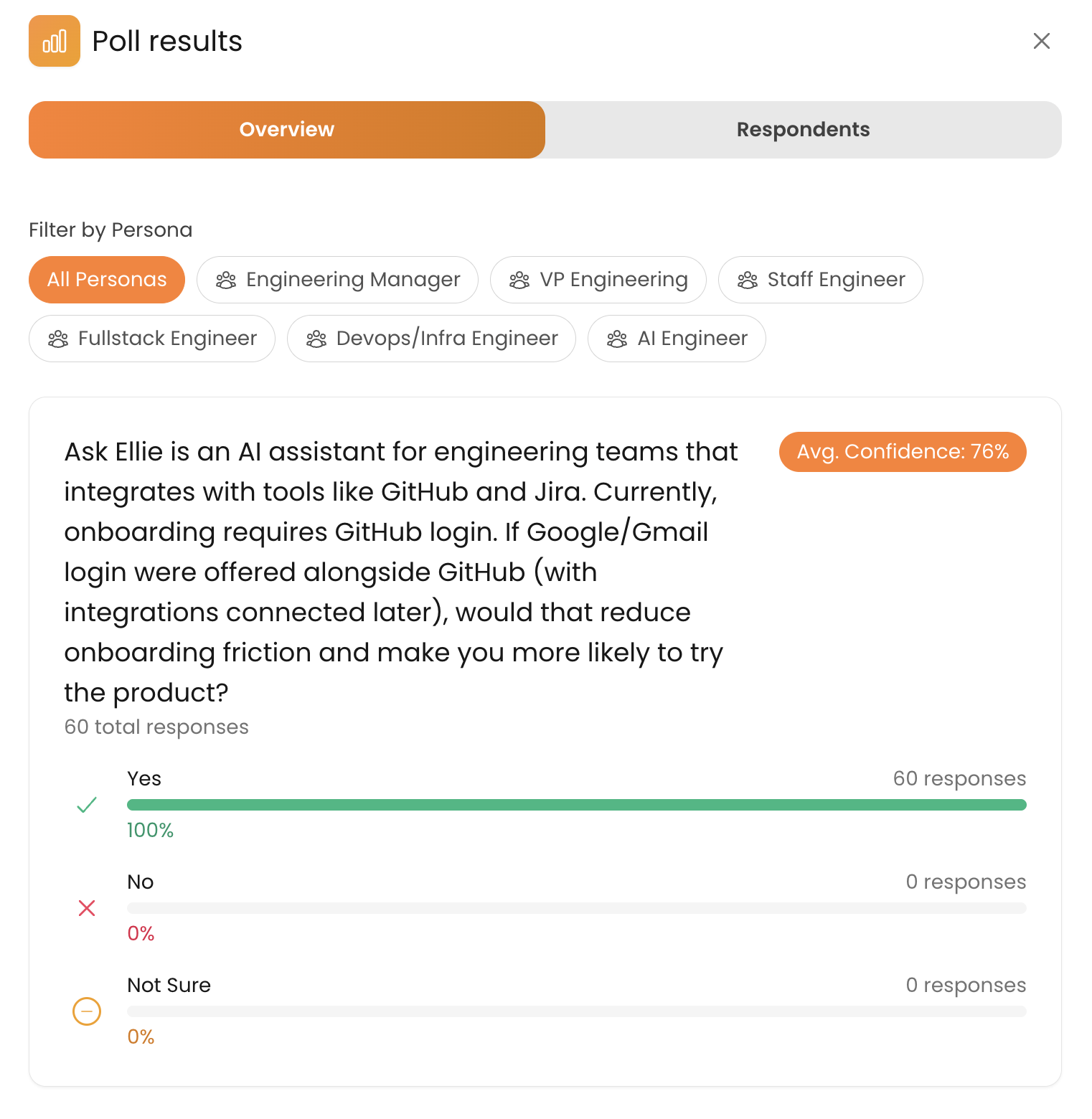
Entelligence also encountered problems when they had open strategic questions like how to position the product. They ran scaled-up instant polls across hundreds of simulated users to support targeted decision & hypothesis validation through Vectorial.
Example hypothesis explored: 'Whether adding Google/Gmail login alongside GitHub login would reduce onboarding friction.' Poll responses indicated low resistance across modeled engineering personas.
Outcomes: What Vectorial Unlocked for Entelligence
Across research, design, and messaging workflows, Entelligence reported directional improvements:
| Area | Before Vectorial | After Vectorial |
|---|---|---|
| ICP Research | Manual calls, high drop-off, no research | 48 hrs saved per cycle, all segments covered |
| Prototype & UX Testing | Internal opinions or no research | 60% faster convergence, multiple variants tested |
| Content Messaging | Guesswork, A/B testing post-publish | Pre-validated, 47% higher engagement |
| Strategic Positioning | Founder intuition, small team debate | Consensus-backed, ICP-validated |
~48 hrs saved
per avoided structured interview cycle
~47% higher engagement
on launch-related communication
~60% faster convergence
from concept → launch lifecycle
5 ICP categories
validated in parallel
Future Workflow Potential
Sakshi & team at Entelligence also identified opportunities for deeper integration of Vectorial into their day-to-day workflows:
- Slack-native decision interactions
- Lower-friction prototype validation loops
- Faster standup-driven queries
"Vectorial changed how we think about launching products. As a lean team, prolonged research cycles, repeated user calls, and subjective iteration loops are expensive. Vectorial helped us explore ICP reactions, validate messaging directions, and identify design considerations much earlier than our previous workflows. It gave both product and growth functions greater confidence while shipping Ask Ellie."
Sakshi Sen
Head of Product & Growth, Entelligence.ai